Gluttony - Philosophical Concept | Alexandria
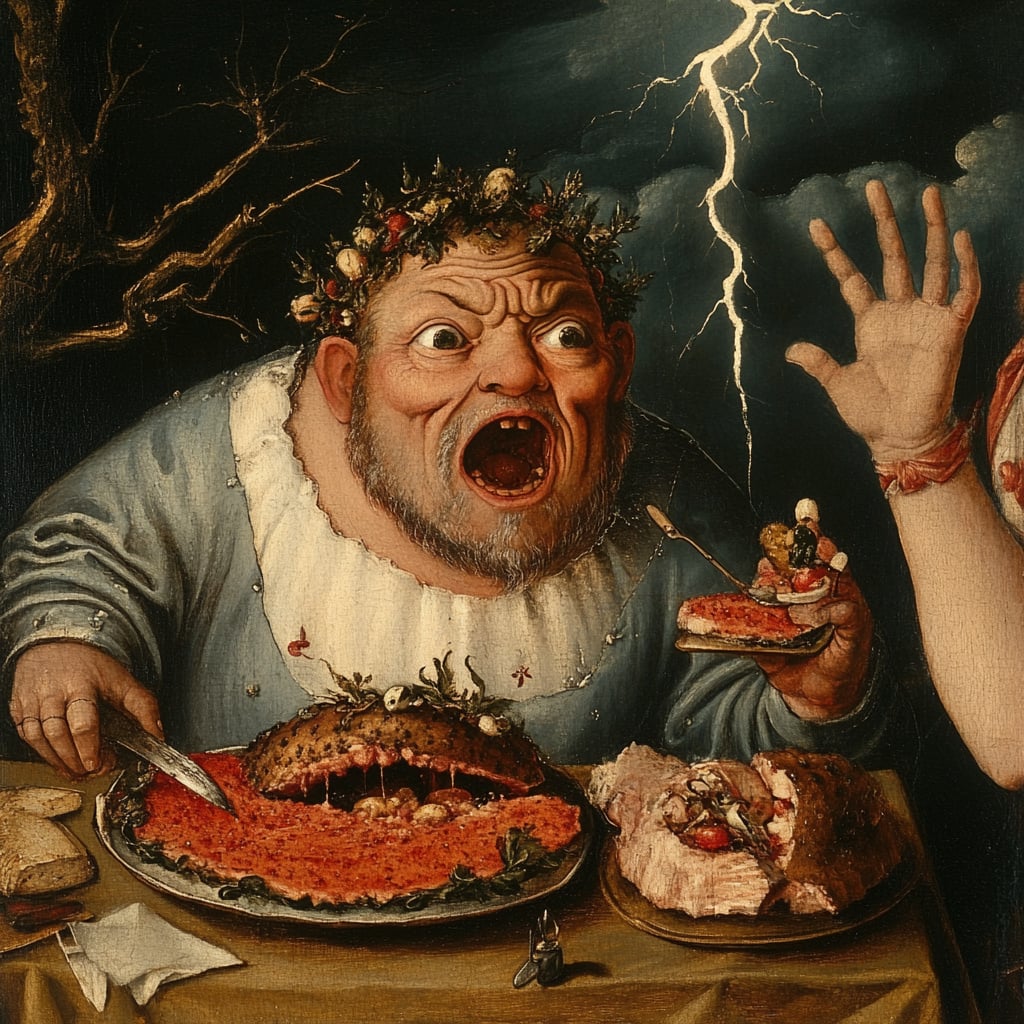
Gluttony, often misconstrued as mere overeating, represents a more profound spiritual and philosophical transgression: an inordinate desire for and consumption of anything, not just food, that transcends reasonable need and purpose. It is a distortion of appetite, a hunger that spills over into greed and excess, challenging our comprehension of moderation, self-control, and the delicate balance that shapes our existence.
The concept of gluttony stretches back to ancient times. Early mentions appear in religious (especially Christian) texts and philosophical tracts, notably within the writings of the early Church Fathers such as St. Augustine (354-430 CE) and St. Gregory the Great (c. 540–604 CE). These thinkers enumerated gluttony as one of the seven deadly sins, framing it as a vice that weakens the spirit and distances one from divine grace. Though philosophers of the time may not have conducted complex thought experiment using the wason test, they did establish a framework for moral reasoning that served as one model for ethical and philosophical inquiry that considered the role that the intemperate played in moral philosophy, impacting both deontology and virtue ethics. The rise of Christianity amidst the decline of the Roman Empire set the stage for interpretations of gluttony that resonated with broader themes of discipline, societal decay, and the pursuit of spiritual purity.
Over the centuries, gluttony's interpretation evolved, often mirroring societal anxieties about wealth, poverty, and moral decay. During the Middle Ages, depictions of gluttony in art and literature served as cautionary tales, illustrating the grotesque consequences of unrestrained desire. The Renaissance witnessed a surge in both lavish displays of consumption and intellectual explorations of ethical dilemmas, leading figures to re-evaluate the sin's place in the social and moral order. From the Reformation to the Enlightenment and beyond, the notion of temperance has been debated in discourse addressing moral principle along the spectrum of subjective morality and objective morality, and moral relativism alongside moral absolutism, sometimes even within an outright existential crisis in which people question their own free will within a seemingly deterministic or compatibilistic, hard determinism and soft determinism, universe. The moral dimensions of overconsumption and its environmental impact are now increasingly scrutinized, offering new perspectives on gluttony's relevance in an age of abundance and unprecedented access, with many modern philosophers such as Peter Singer analyzing the impact of our consumption on others in a moral dilemma context.
Today, gluttony persists as a powerful symbol, resonating with contemporary concerns about consumerism, waste, and the ecological costs of excess, with the questions of fairness bias and equity vs equality remaining prominent. Beyond simple overeating, it reflects a deeper imbalance in our relationship with the world around us. How do we reconcile our desires with our responsibilities, and how can we cultivate a sense of contentment in a society that relentlessly urges us to consume more?