Lewis Carroll - Icon Profile | Alexandria
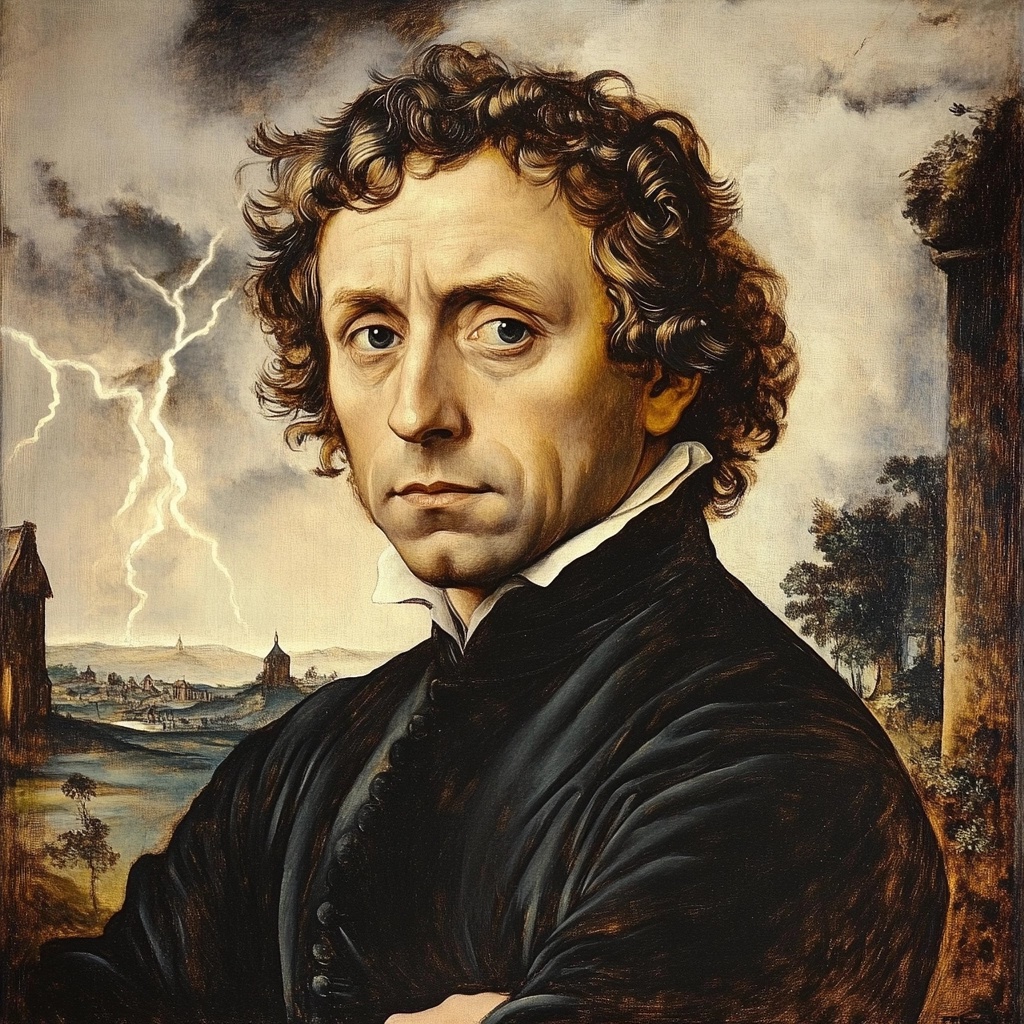
Lewis Carroll (1832-1898), born Charles Lutwidge Dodgson, was an English mathematician, photographer, and author whose literary works, particularly "Alice's Adventures in Wonderland" (1865) and "Through the Looking-Glass" (1871), revolutionized children's literature and continue to intrigue readers with their blend of logic, nonsense, and mathematical precision.
Dodgson's journey began at Christ Church, Oxford, where he excelled as a mathematics lecturer while cultivating his alter ego, Lewis Carroll. His earliest written works appeared in family magazines he created as a youth, displaying an early mastery of wordplay and whimsy that would later define his literary style. The Victorian era's rigid social structures and rapidly evolving scientific understanding provided the backdrop for his creative endeavors, with his work often serving as a subtle critique of contemporary society.
The genesis of Carroll's most famous work occurred on a summer afternoon in 1862, during a boat trip with the three young daughters of Henry Liddell, including Alice, who would become immortalized in his tales. This seemingly innocent riverside story-telling session spawned a literary masterpiece that would challenge conventional Victorian children's literature, introducing sophisticated philosophical concepts and mathematical puzzles wrapped in fantastical narrative. Carroll's work represents a fascinating intersection of mathematical precision and imaginative freedom, evidenced in his precise use of language and logical paradoxes.
Beyond his literary achievements, Carroll was an accomplished photographer during photography's infancy, producing remarkable portraits that remain subjects of scholarly analysis. His personal life and relationships, particularly with the Liddell family, have generated considerable academic discussion, reflecting the complex social dynamics of Victorian England. Today, Carroll's influence extends far beyond literature, inspiring countless adaptations, artistic interpretations, and academic studies in fields ranging from mathematics to psychology. His works continue to pose intriguing questions about the nature of reality, logic, and imagination, demonstrating how the boundaries between sense and nonsense, childhood and adulthood, remain as fluid and fascinating as they were in Victorian times. What deeper truths might still lie hidden in the rabbit holes of Carroll's imagination?